Social Butterfly
Many contacts, low depth — and genuinely fine with that.
 See Dayoff →
How much social contact you want is one question. How deep you want it to go is another. Most of us only ever learned to ask the first.
Many contacts, low depth — and genuinely fine with that.
Many friends, and deep ones too. Bandwidth for both.
Neither many nor deep. Happy alone, no asterisk.
Fewer connections, deeper ones. Almost always mislabeled "introvert."
Fewer connections. Deeper ones. Not shy — selective. Not antisocial — just particular about where your attention goes.
If you've ever left a party that should have filled you up feeling oddly hollow — and then fallen into one conversation that ran past 2 a.m. and felt completely, quietly alive — you already know this cell from the inside.
It isn't a flaw to manage. It's a setting. You've just never had a word for it.
Psychologist Dan McAdams spent decades showing that affiliation — the pull toward warm contact across a group — and intimacy — the pull toward close, mutual connection one person at a time — are independent. You can run high on one and low on the other.
The introvert/extrovert axis smears those two together into a single dial. That's why the label never quite fit.
If you've typed as INFJ, INTJ, or INFP and felt it almost land — this is the sharper cut of the same instinct.
Because they're all built for the top half of that grid. Group feeds optimize for affiliation — more followers, more reach, more noise. Dating apps optimize for one narrow slice of intimacy, on a deadline.
Nothing out there is built for fewer, but deeper.
So the Selective Intimate spends years feeling slightly broken by tools that were never designed for them in the first place.
Every other app bolts messaging on as an afterthought — a tab you reach after the feed, the likes, the follower counts. Dayoff turns that inside out: the conversation is the product.
No followers. No algorithm. No clout to chase. Strangers actually message you — and it stays small on purpose.
A handful of real conversations with the few people worth having them with. Few, but deep — by design.
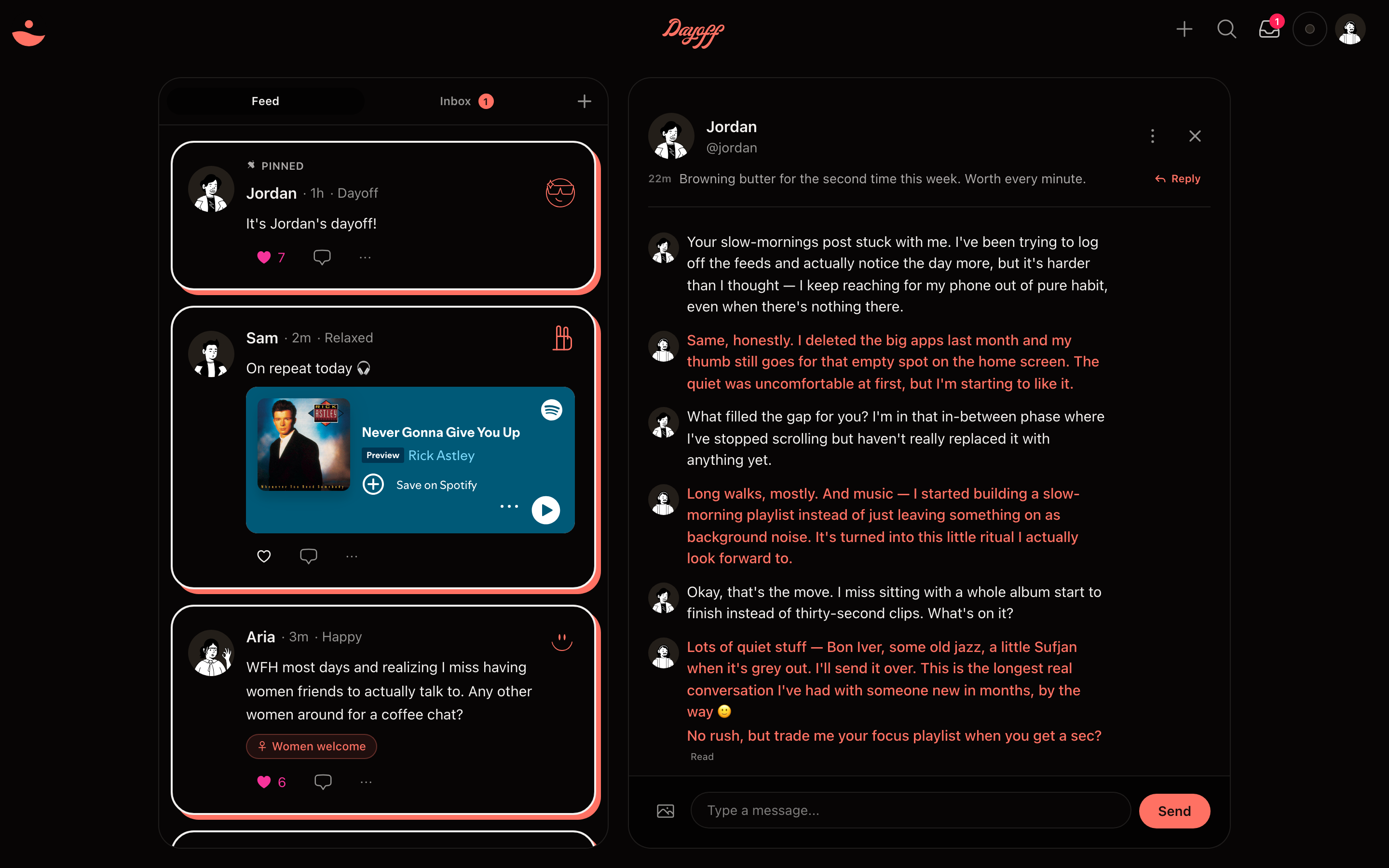
Real conversations. Zero clout.
Fewer, deeper connections only work if being reachable never tips into being overrun. So the openness is yours to set — before a single message lands.
You're never asked to hand over your full identity. A first name is all it takes to start something real — and all anyone ever sees.
Set who's allowed to start the conversation before you post — not after the messages have already arrived.
Require an actual first message, not a one-word "hey." A little effort is the price of your attention.
No followers, no pile-ons, no counts to perform for. Every post opens one quiet conversation — never a stage.
You were never bad at this. You were just in the wrong room.
See Dayoff →